
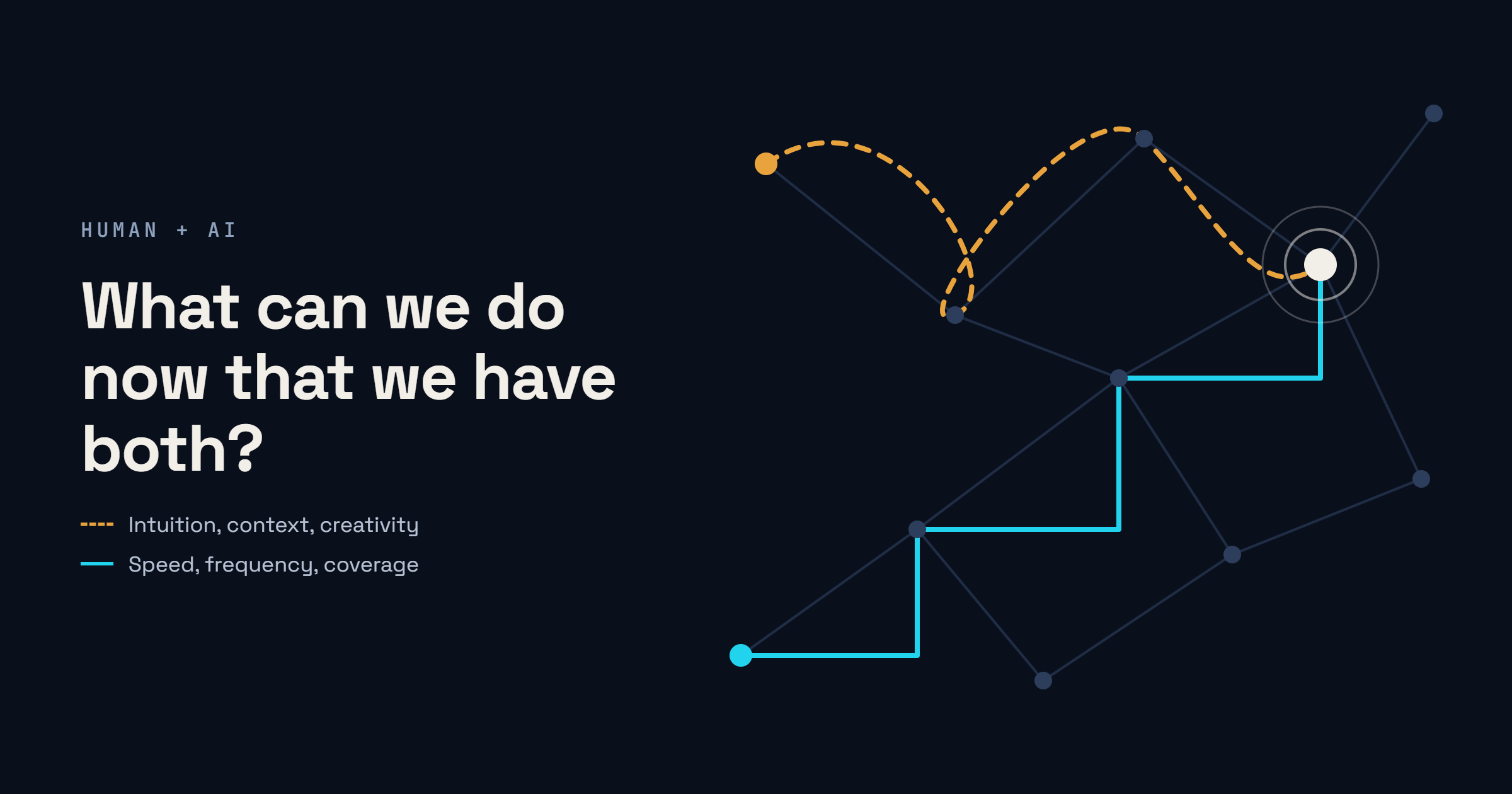
There is a question I keep seeing come up as AI becomes more capable in cybersecurity: Will AI replace penetration testers?
It is an understandable question. We are watching AI systems become capable of doing things that, not very long ago, required significant human involvement, and penetration testing is now part of that conversation. But I think the question itself misses what is most interesting about where the industry is heading.
AI penetration testing and traditional penetration testing do not have to exist on opposite sides of the table. They bring different strengths to security testing, and neither needs to become irrelevant for the other to become valuable. The more interesting question is what security teams can do now that they have access to both.
What Humans Are Exceptionally Good At
A good penetration tester does much more than run through a checklist of vulnerabilities. There is intuition involved. Experienced pentesters notice things that seem unusual, understand business context, and follow unexpected behavior because something about it does not look right. They can change their approach halfway through an engagement because the application is behaving differently than expected.
Sometimes the most interesting vulnerabilities are found precisely because someone decides not to follow the obvious path. That kind of creativity is incredibly valuable, especially when combined with the experience to understand how individual weaknesses might connect to something larger.
Human pentesters can also understand the significance of a vulnerability within the broader context of an organization. The same technical issue can represent very different levels of risk depending on the application, the data involved, the architecture behind it, and the business using it.
Then there is communication. Finding a vulnerability is only part of the job. Someone has to explain why it matters, how it could affect the organization, and what should happen next. Those are meaningful strengths, and the arrival of AI does not suddenly make them disappear.
What AI Changes
AI pentesting introduces a different set of capabilities, and one of the most important is time.
Human penetration testing has always operated within practical constraints. A pentester has a certain number of hours available during an engagement, a security team has a budget, and an organization has to decide which applications should be tested and how often those tests should happen.
Software does not operate on the same schedule. Applications can change every day as developers ship new features, update dependencies, adjust configurations, introduce new endpoints, and modify infrastructure. The application that was tested three months ago may not be the same application running today.
Autonomous testing creates the possibility of testing at a frequency that would be difficult to achieve with human testing alone. An AI system does not need to wait for the next scheduled engagement before it starts testing again. It can repeatedly explore an application, investigate potential weaknesses, and work to validate whether vulnerabilities can actually be exploited.
That does not necessarily make it a better human pentester. It makes it something different, and that distinction matters.
The Space Between Penetration Tests
Traditional penetration testing gives organizations something extremely valuable: a focused examination of their security posture by people who know how attackers think. But every penetration test eventually ends, while the application continues changing afterward.
A development team might deploy a new feature the following week. A configuration might change a month later. A new dependency could introduce an unexpected weakness. None of that means the original penetration test failed. It simply means security is being applied to a moving target.
This is where autonomous testing becomes particularly interesting. Instead of viewing AI as a replacement for the penetration test, we can view it as an opportunity to reduce the amount of time an organization goes without active security testing.
A human team might perform deep testing at important points throughout the year, while autonomous systems test more frequently as the application evolves. Those approaches are not contradictory. They can be complementary.
Maybe We Don’t Need to Pick a Side
Technology conversations have a tendency to become competitions. We ask whether AI will replace developers, security analysts, penetration testers, and countless other professions. But cybersecurity does not benefit from choosing a winner simply because two approaches can accomplish some of the same tasks.
If autonomous testing can handle certain types of repetitive exploration and validation, human pentesters may be able to spend more of their time investigating the difficult, unusual, and context-heavy problems where their expertise matters most. At the same time, organizations gain the ability to test more frequently without trying to turn every security check into a full manual engagement.
That is not a story about one approach eliminating the other. It is a story about expanding what security teams are capable of doing.
AI Pentesting Is Still Evolving
There is another side of this conversation that is equally important: AI pentesting is still developing.
We should be careful about pretending that an autonomous system can perfectly reproduce everything an experienced penetration tester can do. There are situations where human judgment, context, creativity, and experience remain enormously valuable.
At the same time, I think it would be a mistake to judge AI pentesting solely by how closely it can imitate a human pentester. It does not necessarily need to. The real opportunity may come from the things machines can do differently.
Autonomous systems can operate continuously, repeat testing as applications change, and investigate large numbers of potential attack paths without the same time constraints faced by a human team. They can also help validate which findings represent real opportunities for exploitation rather than simply adding another item to an already long vulnerability list. As these systems improve, the boundaries of what they can investigate will continue to expand.
That should be exciting for security teams because, ultimately, we are gaining another tool.
Better Tools Should Let People Do Better Work
There is a tendency to talk about AI primarily in terms of what work it might take away from people. I think there is a much more optimistic way to look at what is happening in penetration testing.
AI could allow security professionals to spend more time on the work that actually requires their expertise. Organizations could test applications more frequently without giving up the depth that comes from human-led assessments. Developers could receive security feedback closer to the moment a vulnerability is introduced, while penetration testers could spend more of their time pursuing the strange, complicated attack paths that require creativity and experience.
Those are outcomes worth pursuing.
The security industry has spent years trying to solve an incredibly difficult problem: applications are changing faster than most organizations can thoroughly test them. Adding autonomous testing to the security toolbox gives us another way to close that gap.
The Future Probably Includes Both
There will be organizations that use autonomous pentesting extensively, situations where a human-led penetration test is clearly the right choice, and increasingly, security programs that use both. That is the future I find most interesting.
For years, penetration testing has been constrained by a simple reality: talented security professionals have limited time. AI changes that constraint, but it does not make human expertise less valuable. If anything, it creates an opportunity to use that expertise more intentionally.
The future of penetration testing may not belong exclusively to humans or AI. It may belong to security teams that understand when to use each.
So when someone asks whether AI pentesting will replace traditional penetration testing, I think there is a better question to ask:
What can we do now that we have both?